 Add to Chrome
 Add to Firefox
 Add to Edge
Proactive Instance Navigation with Comparative Judgment for Ambiguous User Queries
May 07, 2026
Natural-language instance navigation becomes challenging when the initial user request does not uniquely specify the target instance. A practical agent should reduce the user's burden by actively asking only the information needed to distinguish the target from similar distractors, rather than requiring a detailed description upfront. Existing approaches often fall short of this goal: they may stop at the first plausible candidate before sufficiently exploring alternatives, or, even after collecting multiple candidates, ask about the target's attributes derived from individual candidates rather than questions selected to distinguish candidates in the pool. As a result, despite the dialogue, the agent may still fail to distinguish the target from distractors, leading to premature decisions and lengthy user responses. We propose Proactive Instance Navigation with Comparative Judgment (ProCompNav), a two-stage framework that first constructs a candidate pool and then identifies the target through comparative judgment. At each round, ProCompNav extracts an attribute-value pair that splits the current pool, asks a binary yes/no question, and prunes all inconsistent candidates at once. This reframes disambiguation from open-ended target description to pool-level discriminative questioning, where each question is chosen to narrow the candidate set. On CoIN-Bench, ProCompNav improves Success Rate over interactive baselines with the same minimal input and non-interactive baselines with detailed descriptions, while substantially reducing Response Length. ProCompNav also achieves state-of-the-art Success Rate on TextNav, suggesting that comparative judgment is broadly useful for instance-level navigation among similar distractors.

VIRO: Robust and Efficient Neuro-Symbolic Reasoning with Verification for Referring Expression Comprehension
Jan 19, 2026Referring Expression Comprehension (REC) aims to localize the image region corresponding to a natural-language query. Recent neuro-symbolic REC approaches leverage large language models (LLMs) and vision-language models (VLMs) to perform compositional reasoning, decomposing queries 4 structured programs and executing them step-by-step. While such approaches achieve interpretable reasoning and strong zero-shot generalization, they assume that intermediate reasoning steps are accurate. However, this assumption causes cascading errors: false detections and invalid relations propagate through the reasoning chain, yielding high-confidence false positives even when no target is present in the image. To address this limitation, we introduce Verification-Integrated Reasoning Operators (VIRO), a neuro-symbolic framework that embeds lightweight operator-level verifiers within reasoning steps. Each operator executes and validates its output, such as object existence or spatial relationship, thereby allowing the system to robustly handle no-target cases when verification conditions are not met. Our framework achieves state-of-the-art performance, reaching 61.1% balanced accuracy across target-present and no-target settings, and demonstrates generalization to real-world egocentric data. Furthermore, VIRO shows superior computational efficiency in terms of throughput, high reliability with a program failure rate of less than 0.3%, and scalability through decoupled program generation from execution.
RecKG: Knowledge Graph for Recommender Systems
Jan 07, 2025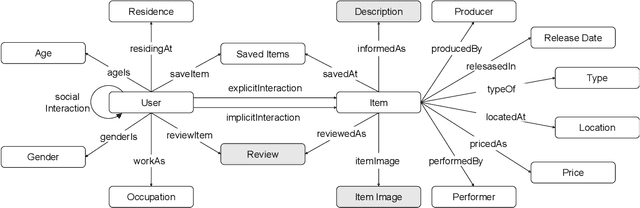

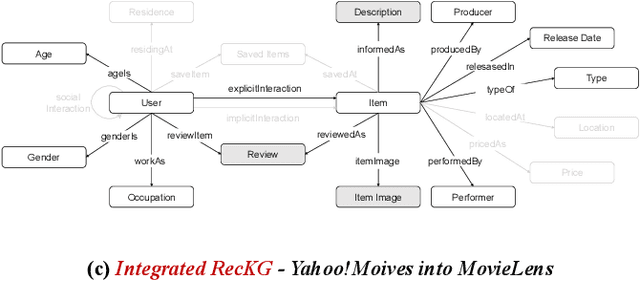
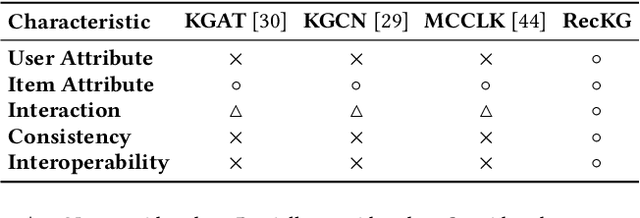
Knowledge graphs have proven successful in integrating heterogeneous data across various domains. However, there remains a noticeable dearth of research on their seamless integration among heterogeneous recommender systems, despite knowledge graph-based recommender systems garnering extensive research attention. This study aims to fill this gap by proposing RecKG, a standardized knowledge graph for recommender systems. RecKG ensures the consistent representation of entities across different datasets, accommodating diverse attribute types for effective data integration. Through a meticulous examination of various recommender system datasets, we select attributes for RecKG, ensuring standardized formatting through consistent naming conventions. By these characteristics, RecKG can seamlessly integrate heterogeneous data sources, enabling the discovery of additional semantic information within the integrated knowledge graph. We apply RecKG to standardize real-world datasets, subsequently developing an application for RecKG using a graph database. Finally, we validate RecKG's achievement in interoperability through a qualitative evaluation between RecKG and other studies.